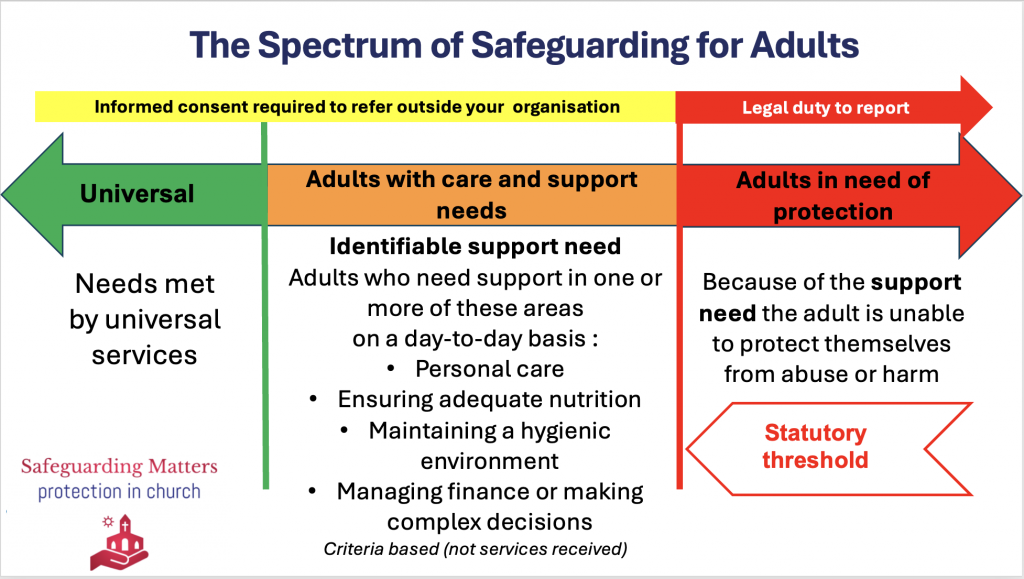
Adults Spectrum of Safeguarding
Each US state has its own Adult Protective Services (APS) laws, but the core idea is very consistent nationwide. The United States services are decentralized and operate through:
- State and county governments,
- Supported by federal laws and funding,
- With significant involvement from non‑profit organizations and private providers.
- Adult Protective Services (APS) and broader social service programs focus on safeguarding, support, and welfare.:
APS is the primary government agency responsible for protecting:
- Older adults (typically age 60+), and
- Vulnerable adults 18+ with physical, cognitive, mental, or developmental impairments.
[pfs2.acl.gov]
What APS Does
APS agencies are mandated in every state. They:
- Receive and investigate reports of abuse, neglect, self-neglect, and financial exploitation,
- Evaluate the adult’s safety and support needs,
- Provide or arrange needed services such as:
- medical/mental health care,
- housing assistance,
- legal support,
- financial help,
- personal care services,
- emergency shelter or protection.
[pfs2.acl.gov]
APS programs vary across states in:
- Who qualifies for a service,
- What services are offered,
- Whether they investigate cases in care facilities.
[congress.gov]
How APS Works in Practice
- Mandatory reporters (certain professionals) must report concerns in most states.
- Reports are screened depending on eligibility definitions (which differ state-to-state).
- In FY2022, APS accepted over 834,000 investigations nationwide.
[congress.gov]
APS is voluntary unless a court determines an adult cannot protect themselves.
General U.S. Definition
A vulnerable adult is typically defined as:
An adult aged 18 or over who, due to physical, mental, cognitive, or developmental impairment, illness, disability, or advanced age, is unable to care for themselves or protect themselves from abuse, neglect, or exploitation.
[legalclarity.org]
Key factors that commonly qualify someone as a vulnerable adult in U.S. law include:
- Physical disabilities
- Cognitive impairments (e.g., dementia, brain injury, developmental disabilities)
- Significant mental health conditions
- Chronic illness
- Advanced age leading to frailty
- Dependence on others for basic needs
Universal
Adults who don’t have any care and support needs and have mental capacity and agency would fit into universal services.They are able to make their own decisions around their life choices whether those choices are eccentric or unwise or unhealthy.
Vulnerable Adults – Adults who have care & support needs
Adults who are in this section are adults who need additional care and support with carrying out everyday living tasks. This can be support with washing and dressing, support with feeding and cooking including shopping and planning what to cook, support with keeping their environment clean, e.g taking the trash out from the home,
Adults in need of protection – Adults who cannot protect themselves from harm.
Adults who are in need of protection are those adults who, because of their support needs are unable to protect themselves from the abuse they are experiencing. By way of illustration, a person who has a support need with their mobility and is experiencing physical abuse, they would be considered to be in need of protectrion as thye are unable to protect themselves.
This is different form someone who is living in a domestic abuse situation. An adult who is able to protect themselves and have capapcity and agency to make thier own decesions can decide to either: –
- A – Report the abuse
- B – Remove themselves from the situation
- C- Choose to leave the relationship
,